AI-Driven System for Real-Time Traceability and Quality Management
This technical disclosure presents an Intelligent Platform for Continuous Quality Management that seamlessly integrates compliance operations directly within the Application Lifecycle Management (ALM) toolchain.
Abstract
This technical disclosure presents an Intelligent Platform for Continuous Quality Management that seamlessly integrates compliance operations directly within the Application Lifecycle Management (ALM) toolchain. The core invention eliminates the costly and error-prone process of manual reconciliation by automating the generation, linkage, and verification of compliance artifacts. Its comprehensive architecture ensures continuous audit readiness, drastically reduces administrative overhead on engineering teams, and transforms quality management into an active, intelligence-driven component of the development lifecycle, enabling teams to maintain regulatory adherence without disrupting established development velocity.
The platform is architected around a Unified Data Model that ensures historical fidelity and is maintained by two primary intelligence vectors:
- External Source Workflows: These specialized agents and processes monitor development toolchains (e.g., Jira, GitHub) via a Change Queue and Orchestration mechanism, performing dedicated source analysis to automatically generate and link compliance entities.
- Co-Pilot Agent: This general-purpose, user-facing agent provides natural language query capabilities and the ability to initiate directed changes against the verified UCDM state.
All proposed changes—whether generated by automated workflows or directed by the Co-Pilot—are subject to a mandatory user review.
Keywords
- Continuous Compliance
- Application Lifecycle Management (ALM)
- Quality Management System (QMS)
- Traceability Graph
- Unified Data Model
- AI Agents / Specialized Workflows
- Human-in-the-Loop (HIL)
- Audit Readiness
- Change Orchestration
Background
Complex engineering has always required tools. Established ALM platforms like Jira, GitHub, and Confluence, benefit from mass adoption across engineering teams and deliver massive efficiency in the mechanics of software creation, enabling rapid iteration, distributed collaboration, and continuous delivery. Yet, for teams operating in regulated environments that require continuous compliance and audit readiness, quality management remains a task tethered to static, passive, often externally managed systems like legacy EQMSs or versioned spreadsheets.
The disconnect is not one of effort, but of automation and integration. Modern software teams are, in practice, already producing the bulk of necessary compliance artifacts: defining requirements, documenting architectural components, creating verifiable test cases, and conducting systematic risk analysis. The core problem lies in the need for auditability and the complex requirement that elements ought to be manually and intelligently traced to other elements. Specifically, humans must:
- Generate, Understand and Normalize compliance entities from disparate source inputs (e.g., turning a Jira story into a formal Requirement).
- Manually Create Linkages between these entities (e.g., connecting a Requirement to a Test Case, a Risk, and a specific Software Component).
- Perform Impact Analysis to verify that a change to one element (e.g., a requirement update) does not invalidate another (e.g., rendering a test case obsolete).
Because a successful quality management process requires context from different teams, this disconnect forces a costly and manual reconciliation between development actions and compliance artifacts. The linkage, documentation, and historical accuracy required for formal compliance (such as in regulated industries) are not an intrinsic output of the development tools, but a tedious, post-facto process.
Description
This disclosure details an Intelligent Platform for Continuous Quality Management that directly integrates compliance operations into the Application Lifecycle Management (ALM) toolchain. The system is engineered to eliminate the manual reconciliation process between dynamic development activities and formal, static compliance documentation, thereby allowing teams to simply review the system's generated outputs. The platform is built atop a Unified Data Model that allows dedicated agents and workflows to natively suggest changes to existing data, while also allowing users to manually edit.
At its core, the platform offers two non-manual flows: the external source flow and the co-pilot flow, as described in Figure 1 below:
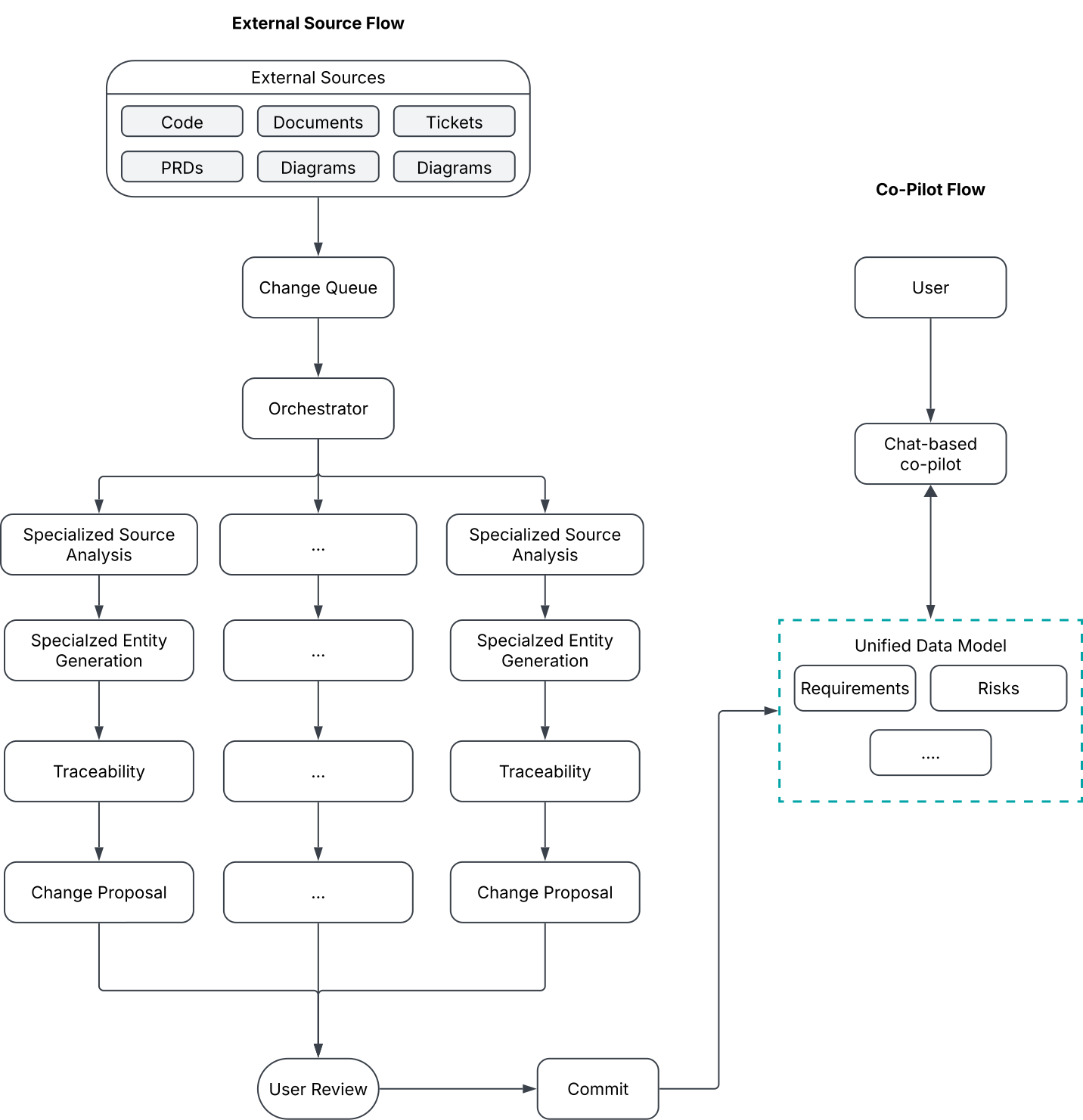
Data Model
The core framework is naturally dependent on a Unified Data Model that is representative of all entities required for continuous compliance, such as requirements, components, risks, and verifications. A Unified Data Model serves as a natural foundation through which the platform is able to deliver on its core duties as a quality management system. All records are historically maintained and versioned, and made available to downstream agents and workflows, as well as users. The Data Model naturally makes it possible for workflows, agents, and users to manipulate common entities.
External Sources Workflows
Change Queue & Orchestration:
When connecting to external toolchains, or processing custom requests for users (e.g. a non-descript file-upload), elements are placed into a Change Queue as events and passed to an Orchestrator. Based on an initial analysis of the changes presented by the new or modified external source, the orchestrator prepares the necessary context to invoke the correct dedicated workflows.
Entity Generation & Traceability:
Once invoked, the specialized workflow will perform a specialized analysis of the external source. Depending on which workflows are invoked over a specific external source, source analysis will produce differingly-shaped artifacts for further downstream processing. For example, when analyzing code to extract software architecture items, code-specific tools are made available to this node's agentic operator.
The specialized workflows then review and optionally can transform the analyzed artifacts into well-formed entities that are compatible with the Unified Data Model. Specialized workflows can be easily initialized with access to appropriate tooling based on the entity to be generated, providing context into the rest of the existing compliance stack.
The specialized workflows are then able to suggest traceable changes introduced by the new or updated entities. Downstream or upstream changes may be required to accommodate the new or updated entities (e.g. changes to a requirement require changes to a downstream test case).
Change Proposals:
All generated outputs (entities, linkages, suggestions) are collected into a Proposed Change Set and routed for mandatory review by the user. Upon approval, changes are committed to the Unified Data Model.
Co-Pilot
Beyond the automated, event-driven workflows, the platform incorporates a general-purpose, user-facing co-pilot with full access to the Unified Data Model. This agent can leverage the entire, verified state of the Data Model to answer any question, and affect or suggest any change using natural language queries.
Conclusion
The platform transitions the Quality Management System from a passive record storage system to an active, intelligence-driven participant in the product development lifecycle. The core invention eliminates the costly and error-prone process of manual reconciliation by automating the generation, linkage, and verification of compliance artifacts. Built atop a Unified Data Model that ensures historical fidelity and traceability, the platform operates through two primary intelligence vectors to reduce the overhead of all personnel, ensuring that software, hardware, and compliance teams maintain continuous alignment and high quality with minimal administrative distraction.